This past weekend I went fencing for the first time, and became fascinated by the sword — a foil. When one fencer hits another, the foil buckles and deflects upward at the middle.
That direction is critical. If the foil deflects the wrong way — downward — the tip can slide up under the opponent’s protective mask.
So this week: the buckling of a fencing foil, and how its cross-sectional geometry might guarantee it buckles in the right direction.
Buckling is the point
It’s worth noting that the sword buckling is desirable. It takes roughly 7.5 N on the button at the tip to register a hit, and fencers are taught to impart more than the minimum to make sure the hit lands. That extra force is what buckles the blade.
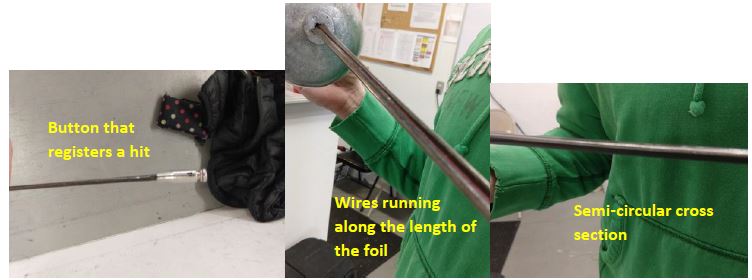
Looking closely at the foil afterwards, I noticed the semi-circular cross section and the taper along its length, and my instinct said both were deliberate.
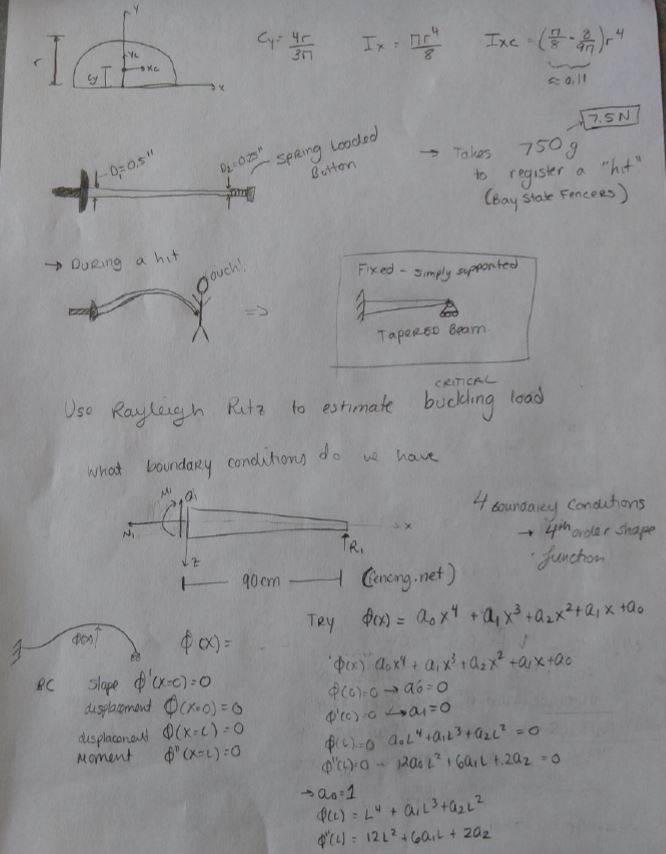
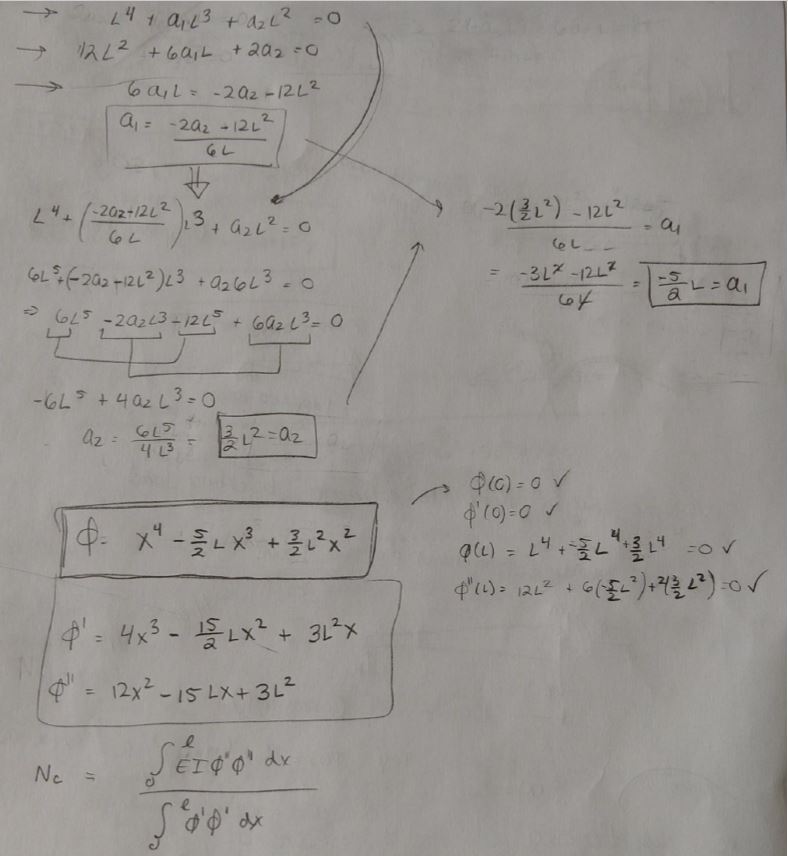
Four boundary conditions — zero slope and displacement at the fixed end, zero displacement and moment at the tip — mean a fourth-order trial function.
The taper makes it messy
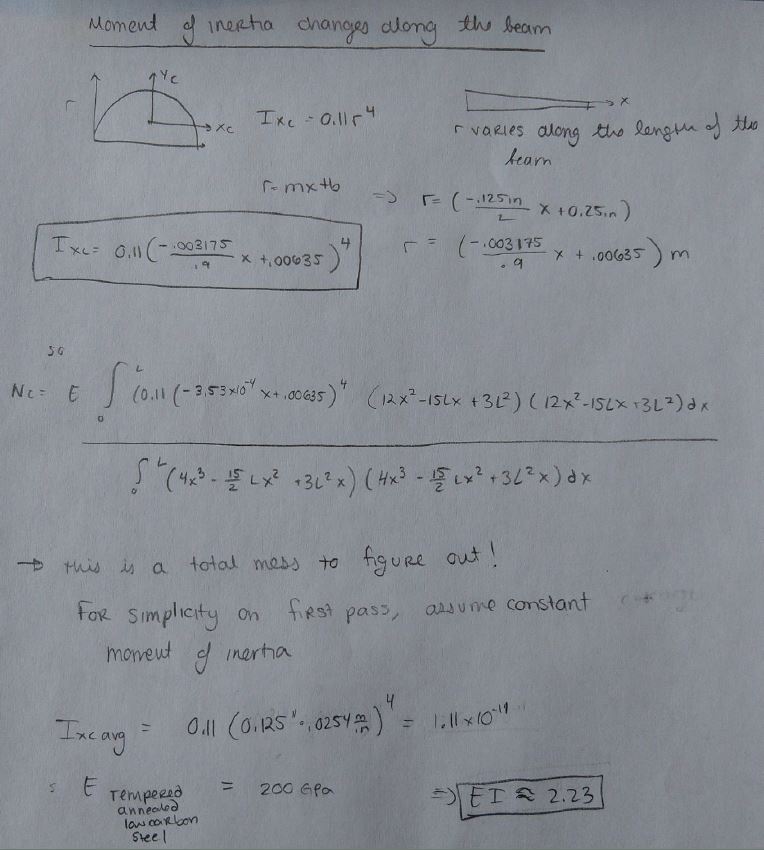
The radius varies along the blade, so the moment of inertia does too — and carrying that through the Rayleigh-Ritz integral gets ugly fast. For a first pass I took a constant average moment of inertia instead, giving EI ≈ 2.23.
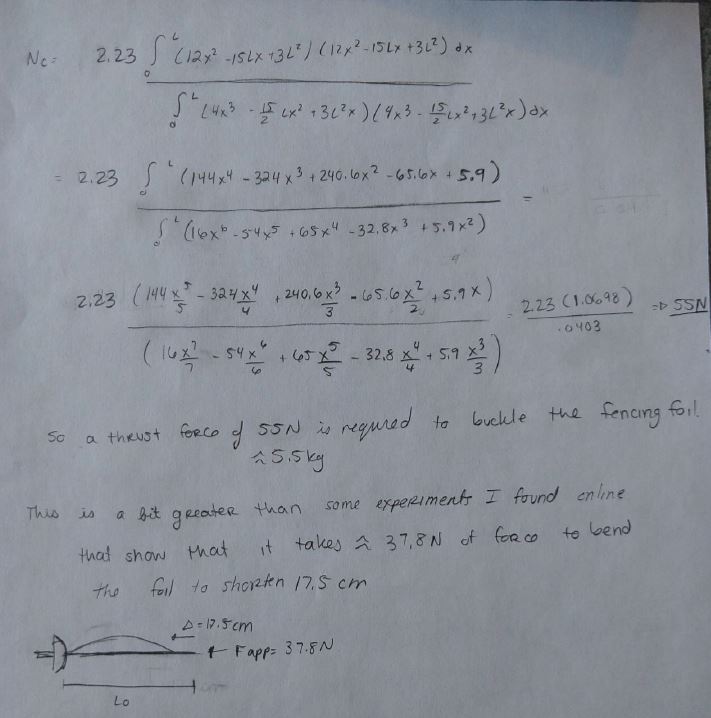
| Predicted buckling load | 55 N (≈ 5.5 kg) |
| Published experiment | ~37.8 N to shorten the foil by 17.5 cm |
Higher than the measured value, and there are good reasons why.
Why the prediction runs high
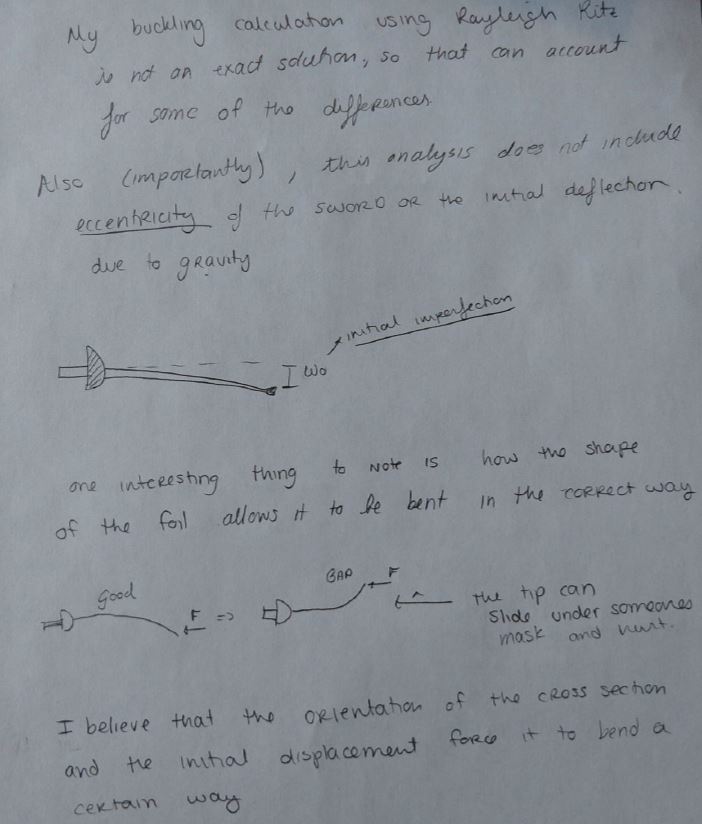
Rayleigh-Ritz gives an upper bound rather than an exact answer, so some overshoot is expected. More importantly, the analysis leaves out the eccentricity of the blade and its initial deflection under gravity — a real foil is never the perfectly straight column the idealisation assumes.
And that imperfection is exactly what makes the mechanism safe.
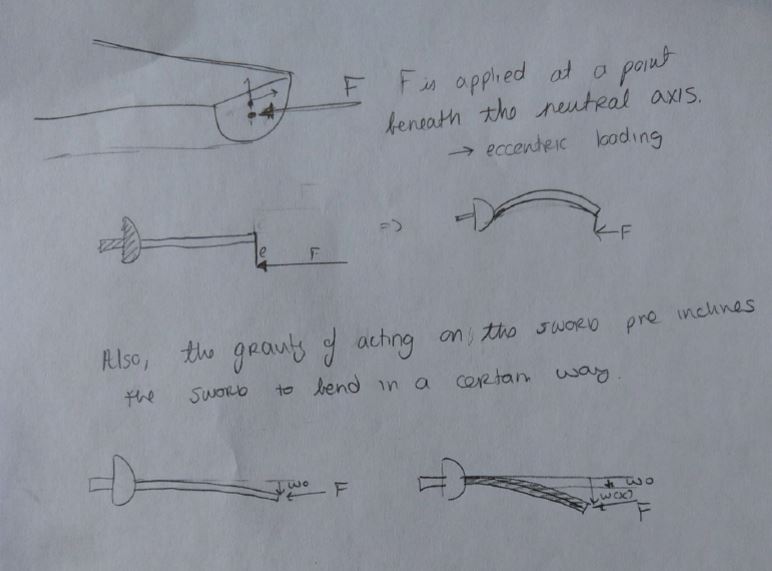
The force lands beneath the neutral axis of the semi-circular section, so the loading is eccentric — it carries a moment that bows the blade in one particular direction. Gravity adds an initial deflection that biases it the same way.
Between the cross-section orientation and that initial displacement, the foil is made to bend upward, away from the opponent’s mask. A safety property falling out of the section geometry rather than a separate mechanism.