Highlights
- Hardware and software subject matter expert for the Robotic Arm and Setup Arm (RASA) subsystems
- Mechanical technical lead on a robotic arm actuator brake failure investigation — tolerance stack analysis, vendor testing, failure cause mapping
- Led a redesigned Instrument Drive Unit (IDU) Simulink software architecture from concept to a deployable prototype in one PI
- Developed a custom software controller for a robotic surgical instrument jaw via system identification
I joined Medtronic full-time right after my contract R&D role, starting as a Controls Software Engineer II and moving up to Senior Mechanical Design Engineer and Senior Controls Software Engineer — a dual role that has me working both sides of the hardware/software line on Medtronic’s Hugo™ robotic-assisted surgery (RAS) system.
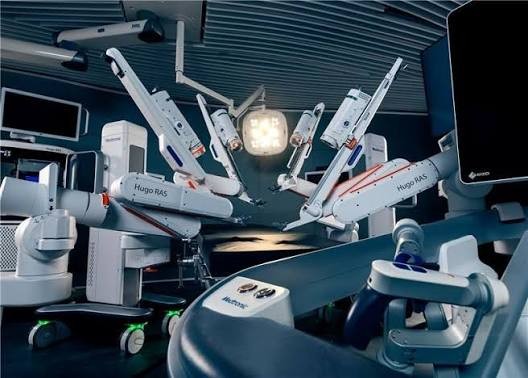
The Hugo™ RAS system. Image: Medtronic.
Most of my time has centered on Hugo’s Robotic Arm and Setup Arm (RASA), where I’ve become the go-to person for both the mechanical hardware and the software that drives it. That’s meant leading a field brake failure investigation from root cause through vendor testing and a full engineering report, designing the mechanical layout for the next-generation arm’s brake and release system to IEC 60601 medical compliance, and — on the software side — championing a redesign of the Instrument Drive Unit’s Simulink control architecture that went from concept to a working deployable prototype within a single planning increment.
I’ve also worked on the Wristed Ligasure robotic instrument end-to-end: deriving software and performance requirements from system investigations, building a plant model into a simulator so the control software could be tested without hardware in the loop, and running system identification to develop a custom jaw controller. For about a year and a half I was also the team’s SAFe-certified product owner, prioritizing the RASA lower-level joint control backlog.
A lot of the mechanical work is physical. I 3D-print a wide range of components to test mechanisms and concepts for the next-generation robot — actuator housings, brake mechanisms, housing covers, and the fixtures and brackets used to test them — on Stratasys J35 Pro (PolyJet), Formlabs (SLA) and Bambu Lab (FDM) printers. On the analysis side I run FEA on the robot arm structure for the loading it actually sees, which depends both on the robot’s configuration and on the loads users apply to it. Designing those parts for manufacture is part of the job throughout. We also run user studies, gathering feedback on design concepts and learning what users are looking for before a design goes further.
It’s the kind of role that keeps me equally fluent in SolidWorks and Simulink — some weeks are entirely about tolerance stacks and vendor coordination, others are entirely about control architecture, and most weeks are both.
Outside the day-to-day