I’ve used C-clamps constantly through this class to hold parts while running tests, and I wanted to understand where the mechanical advantage of a square-threaded screw actually comes from.
Three questions:
- What is the mechanical advantage?
- Can you break the handle?
- When will the structure of the clamp yield?
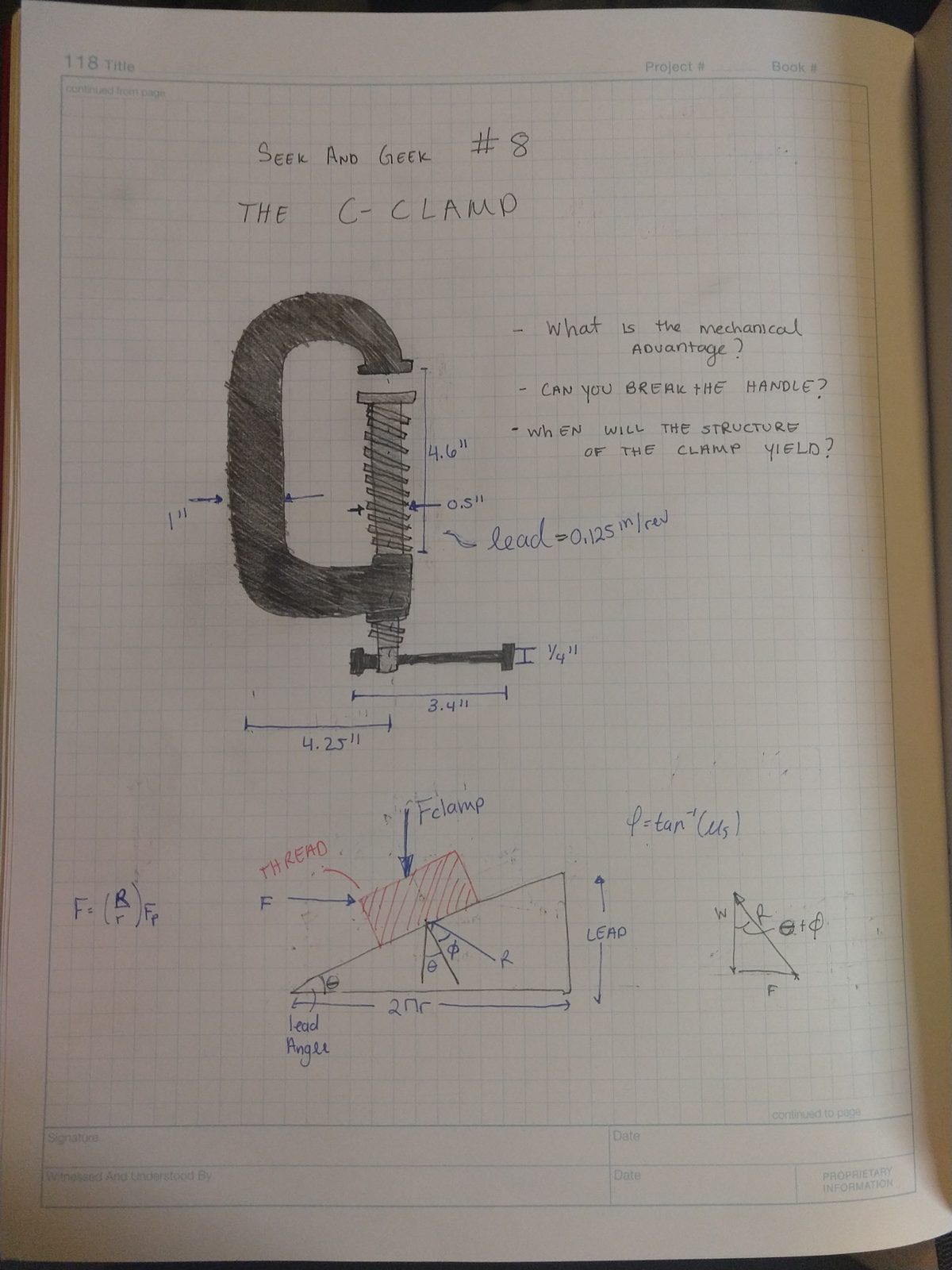
The screw as an inclined plane
The standard trick: unwrap one turn of the thread into an inclined plane whose base is the circumference 2πr and whose rise is the lead.
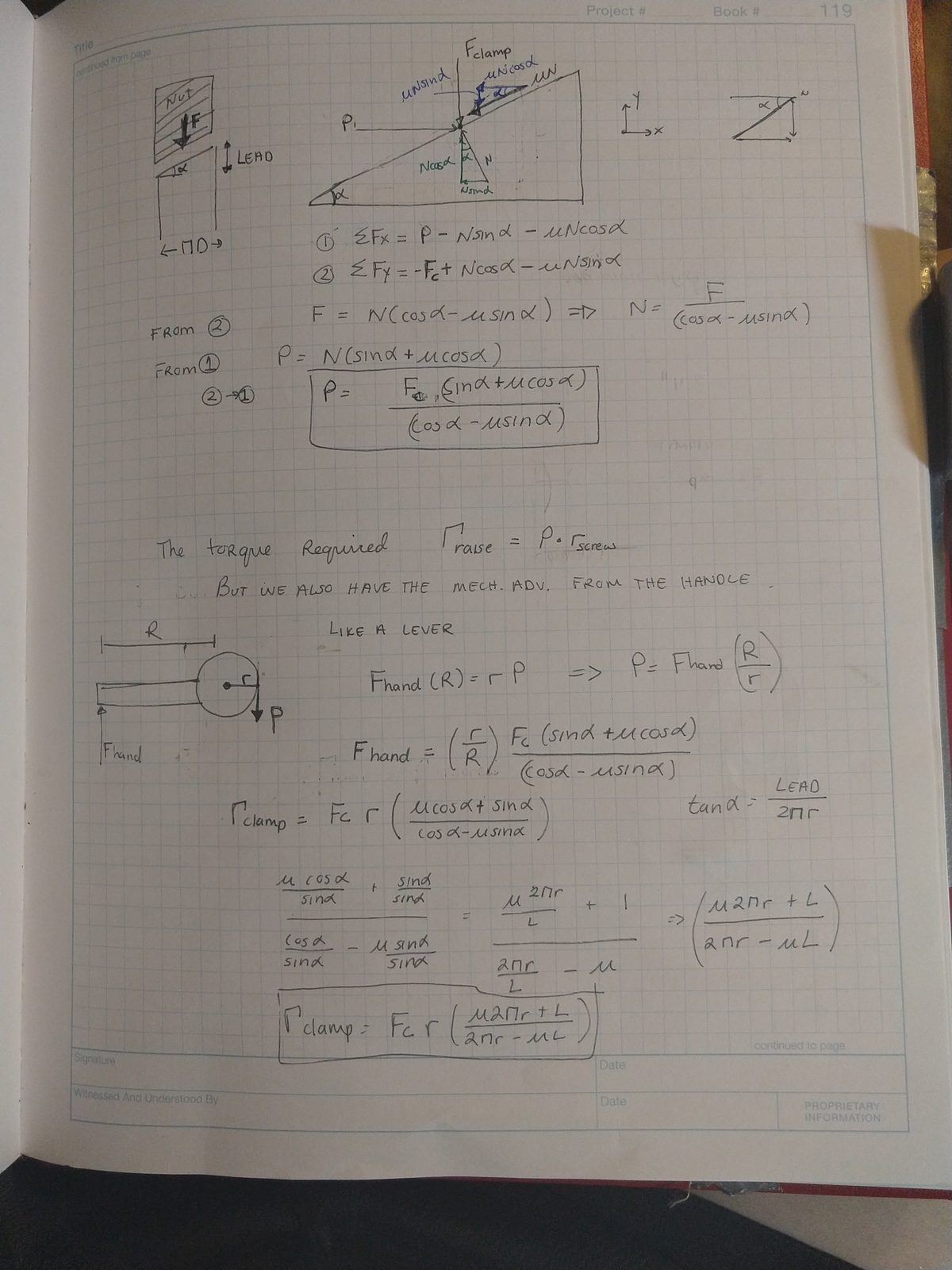
Balancing forces on the thread gives the tangential force P needed at the screw for a given clamping force, and since the handle is a lever of radius R acting on a screw of radius r, the two combine into a single expression for clamping force per unit hand force.
How hard can a person actually clamp?
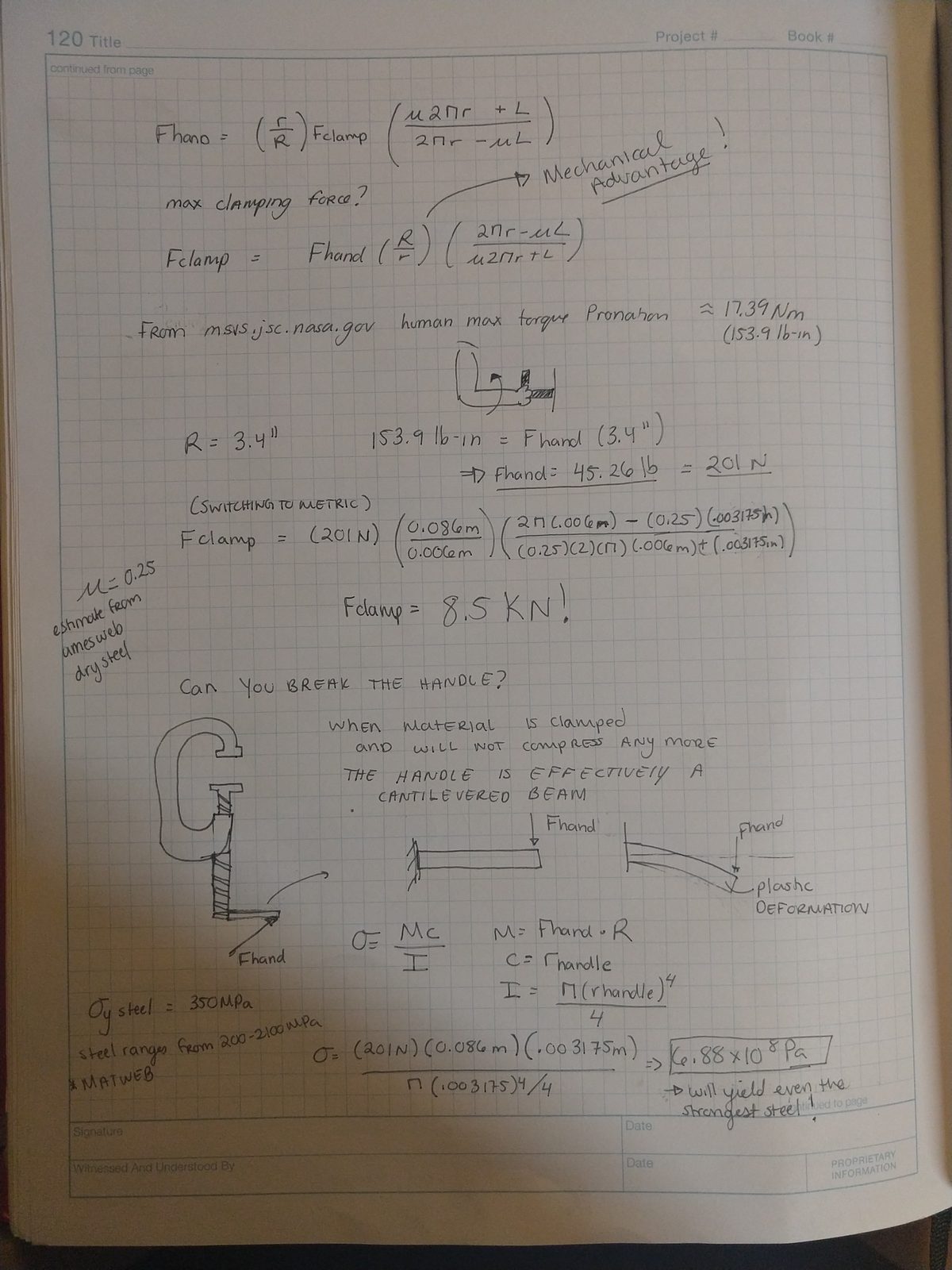
| Max human torque (NASA data) | 17.39 N·m (153.9 lb·in) |
| Handle radius | 3.4” |
| Hand force at the handle | 201 N (45 lb) |
| Friction coefficient, dry steel | 0.25 |
| Resulting clamping force | 8.5 kN |
That’s the mechanical advantage of the square thread in one number — 201 N at your hand becomes 8.5 kN at the workpiece.
Which fails first?
Once the clamped material stops compressing, the handle is effectively a cantilever, so any further hand force just bends it. At full human torque the bending stress reaches 6.88 × 10⁸ Pa — enough to yield even the strongest steel. Which matches the everyday experience that bent handles are a common failure on smaller clamps.
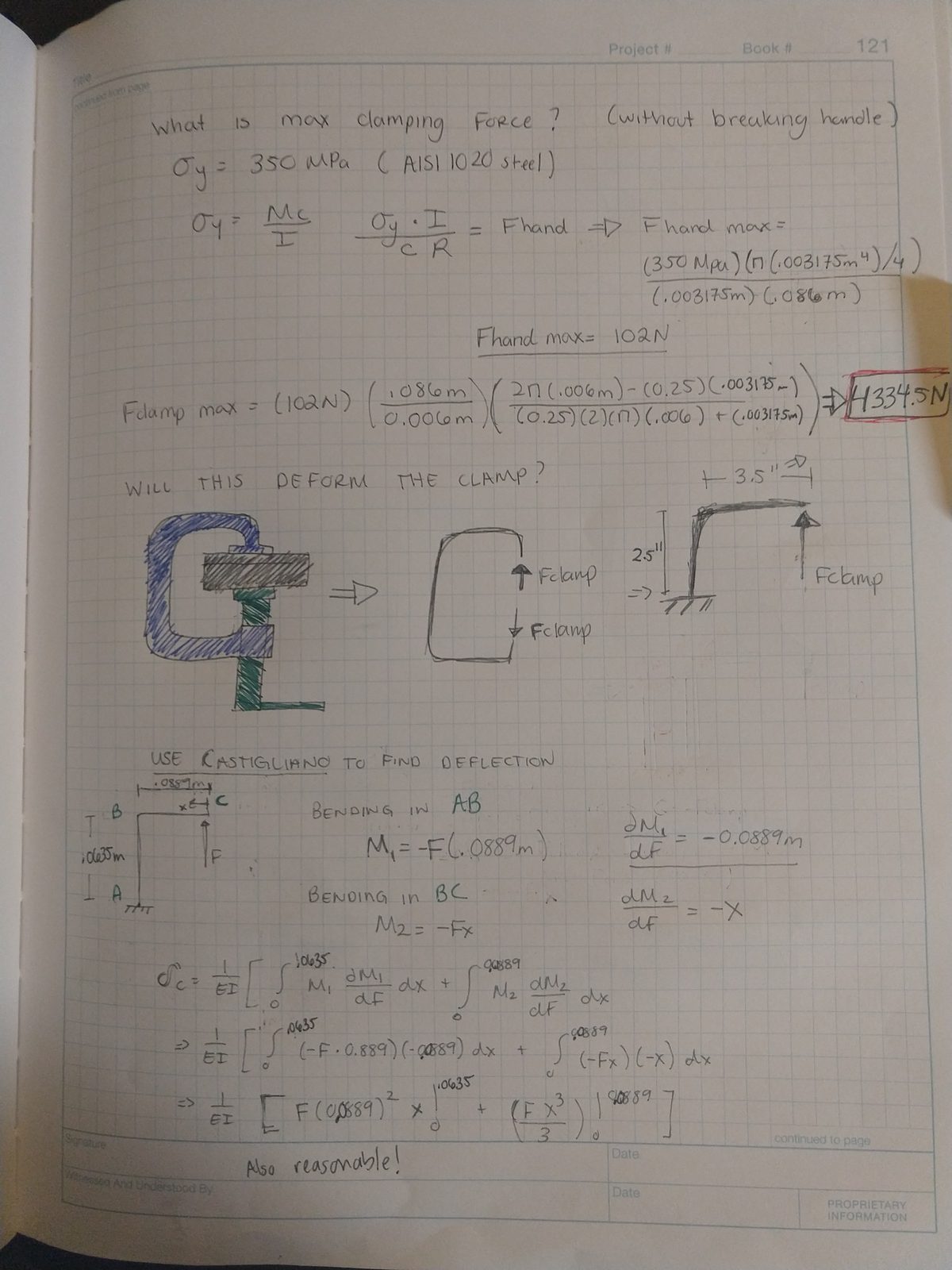
So the handle sets the real limit, not the person:
| Handle yield stress (AISI 1020) | 350 MPa |
| Max hand force before the handle yields | 102 N |
| Max clamping force | 4334.5 N |
Will the clamp body deform?
Castigliano’s method on the C-frame, splitting it into the two bending segments and integrating.
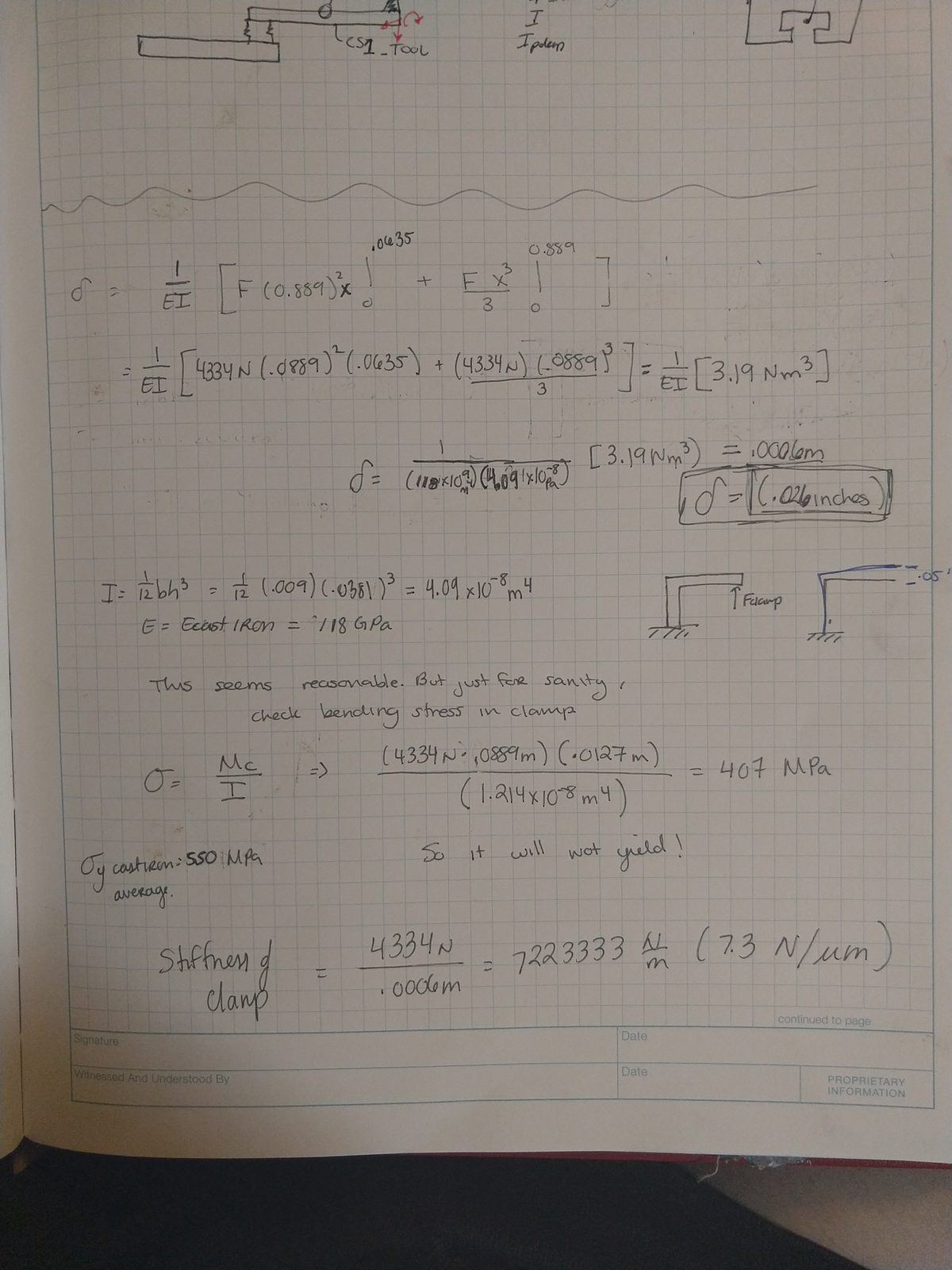
| Deflection at max clamping force | 0.0060 cm (0.026”) |
| Bending stress in the frame | 467 MPa |
| Cast iron yield (average) | 550 MPa |
| Clamp stiffness | 7.3 N/µm |
So the frame holds — 467 MPa against a 550 MPa yield — and the clamp deflects about 26 thousandths of an inch at maximum clamping force. Both reasonable.
The answer to “which part gives out first” is the handle, by a wide margin, and it does so at less than half the force a person could otherwise apply.