In June 2020, Micron Technology announced a design challenge for reliable, low-cost ultraviolet robotic disinfection — automating the job of sterilizing a room to help slow the spread of COVID-19 and other diseases. The brief was to build something that cost under $10,000 to manufacture and was safe to operate in cluttered spaces with a lot of human traffic.
My labmate Jerry Ng and I entered with a second goal of our own. Our advisor, Harry Asada, teaches MIT’s Introduction to Robotics course every year, and we wanted a platform his students could actually use — hardware and software expandable enough that a team could bolt on their own functionality and reach the robot remotely through a server. I owned the mechanical design and fabrication; Jerry owned the software architecture, including the mobile platform kinematics and teleoperation.
The requirements that shaped it
The challenge set hard numbers, and most of the mechanical design falls directly out of them:
| Requirement | Target |
|---|---|
| Physical envelope | ≤ 0.6 × 0.6 × 2 m — must fit a standard doorway |
| UV lamp coverage distance | 0.3 m min / 2 m max |
| Push force | < 8 kg, so a relatively weak person can move it |
| Weight | < 150 kg, so it moves on standard equipment |
| Time to kill dose at 2 m | < 300 s |
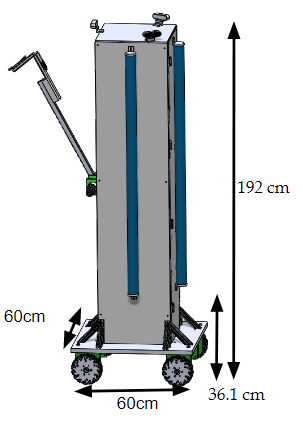
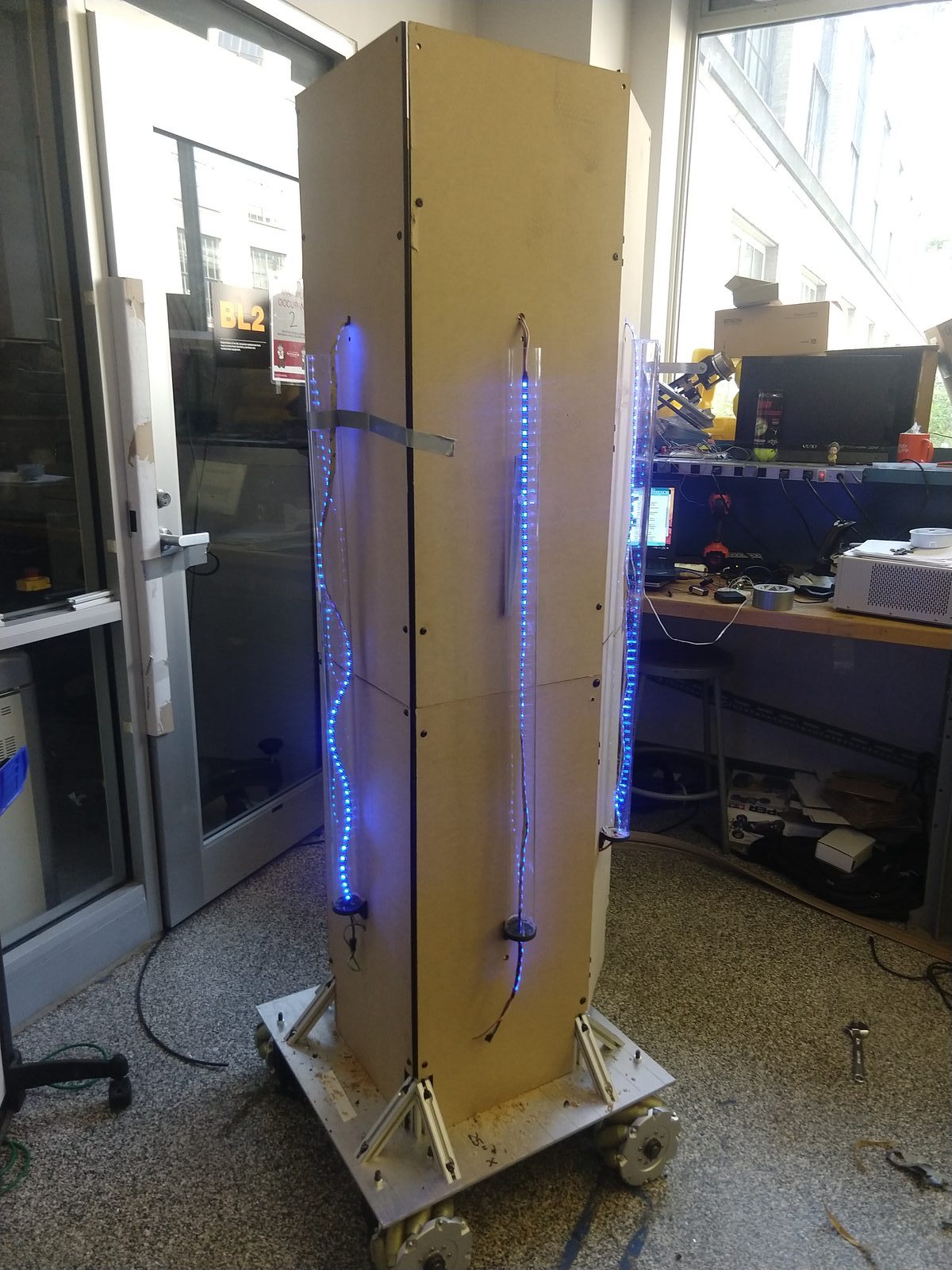
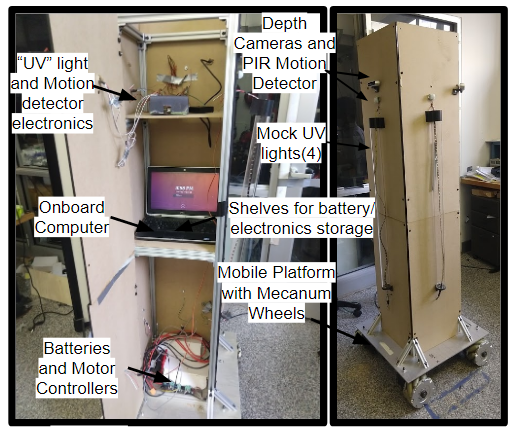
The form is a roughly five-foot 80/20 tower sitting on a mobile platform, 192 cm tall assembled and 60 cm square — inside the envelope on all three axes. At least four UV lamps mount to the tower’s panel siding. Each panel is hinged, so every electronic component behind it is one swing away rather than a disassembly job, and the interior is shelved to hold the batteries and controllers and to leave room for whatever a student team wants to add later. RealSense depth cameras sit on top for teleoperation and SLAM.
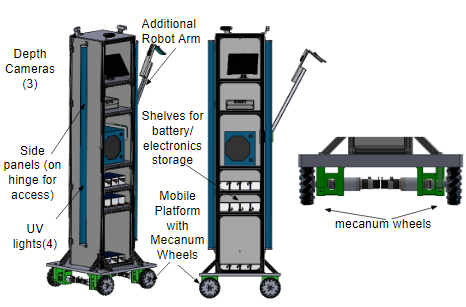
The base runs direct-drive mecanum wheels. For a machine that has to work its way around furniture in an occupied room, the ability to translate sideways without first turning is worth more than the efficiency a conventional differential drive would buy.
The mass problem
The two most interesting requirements pull against each other. The robot has to be light enough that one person can push it, and it also has to not fall over when they do — and “not falling over” is what sets a lower bound on its mass.
Taking a 5’6” person pushing at a comfortable 1.2 m height with 80 N against a wheel track that puts the tipping edge 0.19 m off centerline, the moment balance says the robot has to weigh at least 51.5 kg to stay down.
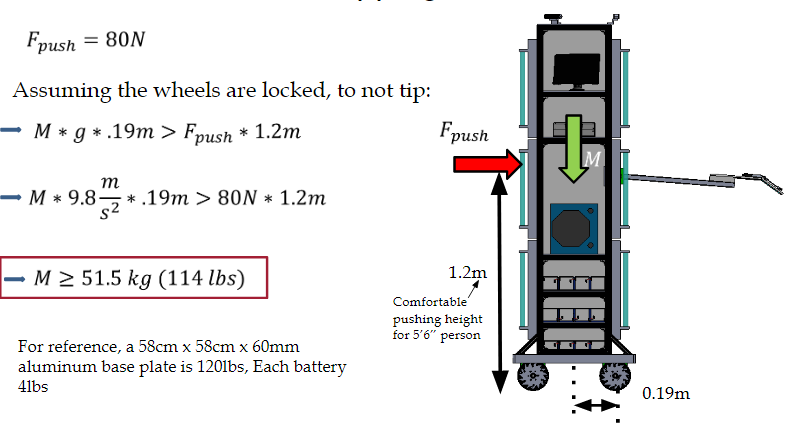
That bounds the design between 51.5 kg and the challenge’s 150 kg ceiling. The second stability case — the robot parked on a 10° incline — constrains not mass but where the mass sits: the center of gravity has to stay below 1.07 m to remain stable, and I held it under 0.5 m to leave margin for the loads from sudden starts and stops.
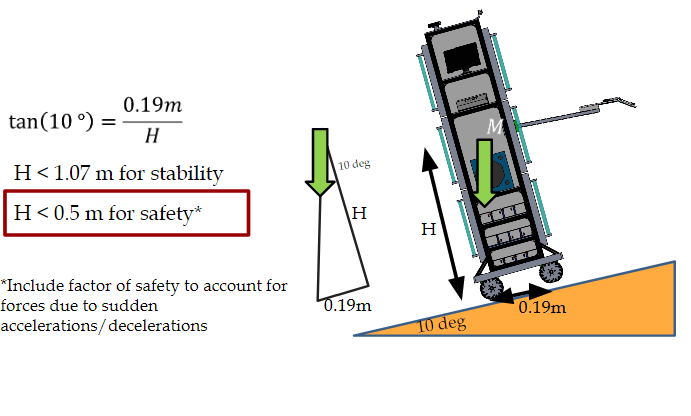
A center of gravity under half a meter on a machine almost two meters tall is the constraint that explains the rest of the layout. Everything dense goes at the floor: a thick aluminum base plate carrying most of the required mass, batteries and motor controllers on the lowest shelf, and nothing heavier than a camera near the top.
Safety interlock
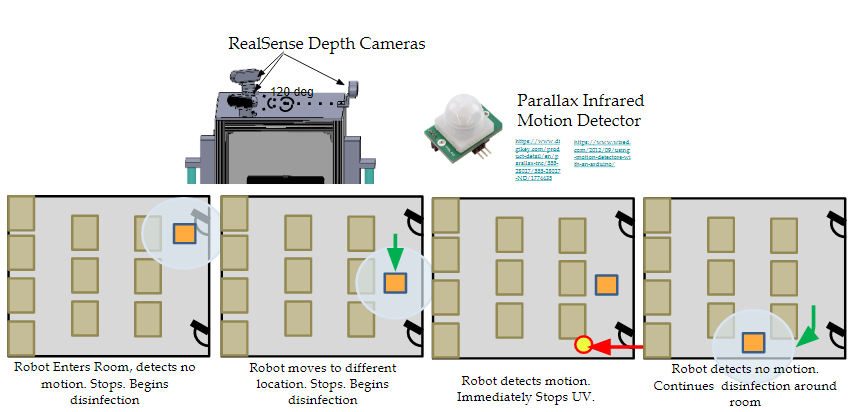
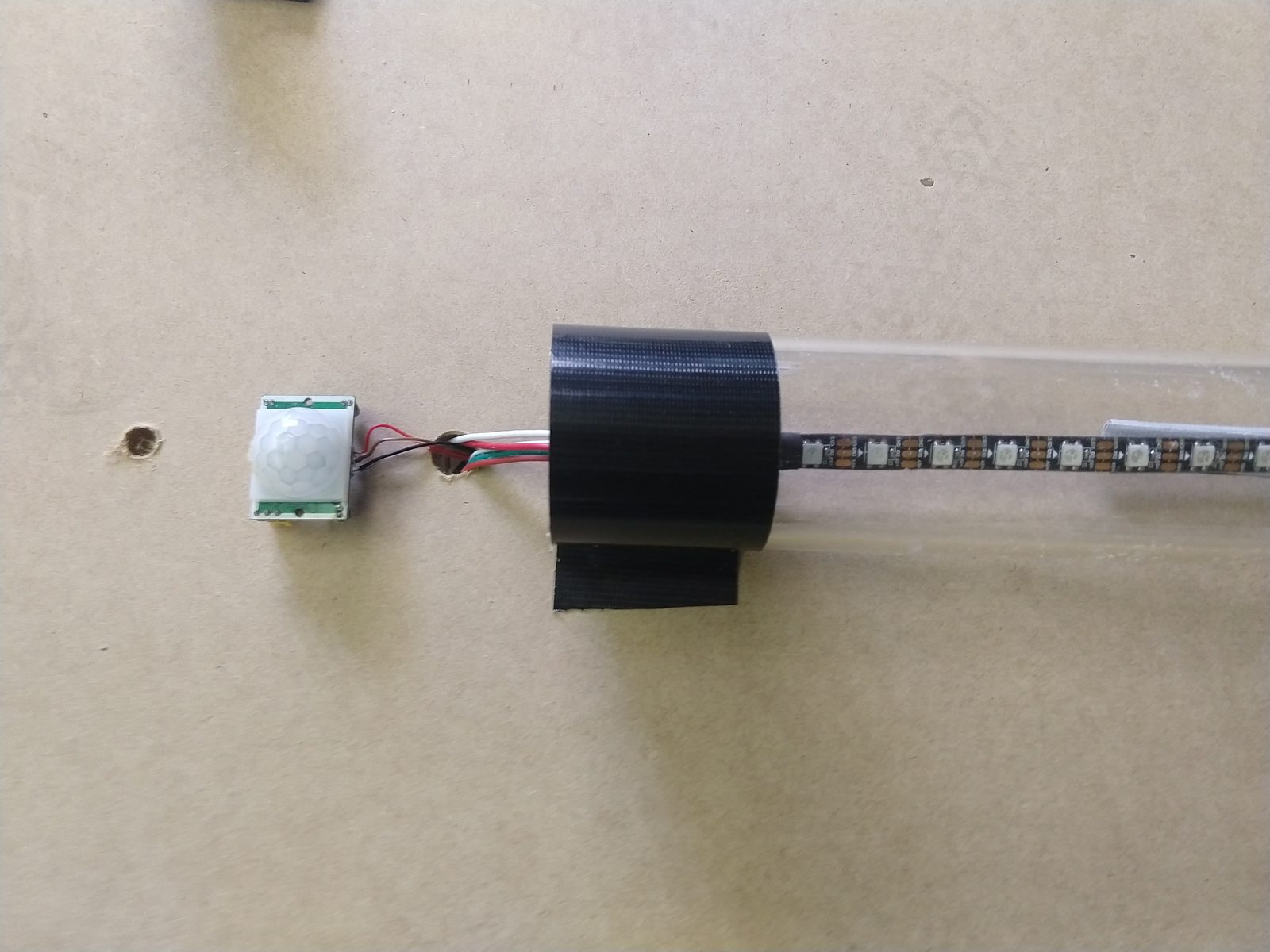
Germicidal UV damages people at close range, so the lamps had to shut off whenever anyone was near. We used infrared motion detectors driven by an Arduino Mega alongside the depth cameras: the robot moves to a position, confirms the room is still, and only then begins a disinfection cycle — killing the lamps the moment it sees motion and resuming once the room clears.
Building it
I manufactured a prototype over the summer. Germicidal UV lamps were in short supply in 2020, so the four lamps on the prototype are mock-ups — acrylic tubing with addressable LED strips inside, matched to the real lamps’ size and mounting so the structure, wiring, and interlock could all be built and tested against something physical.
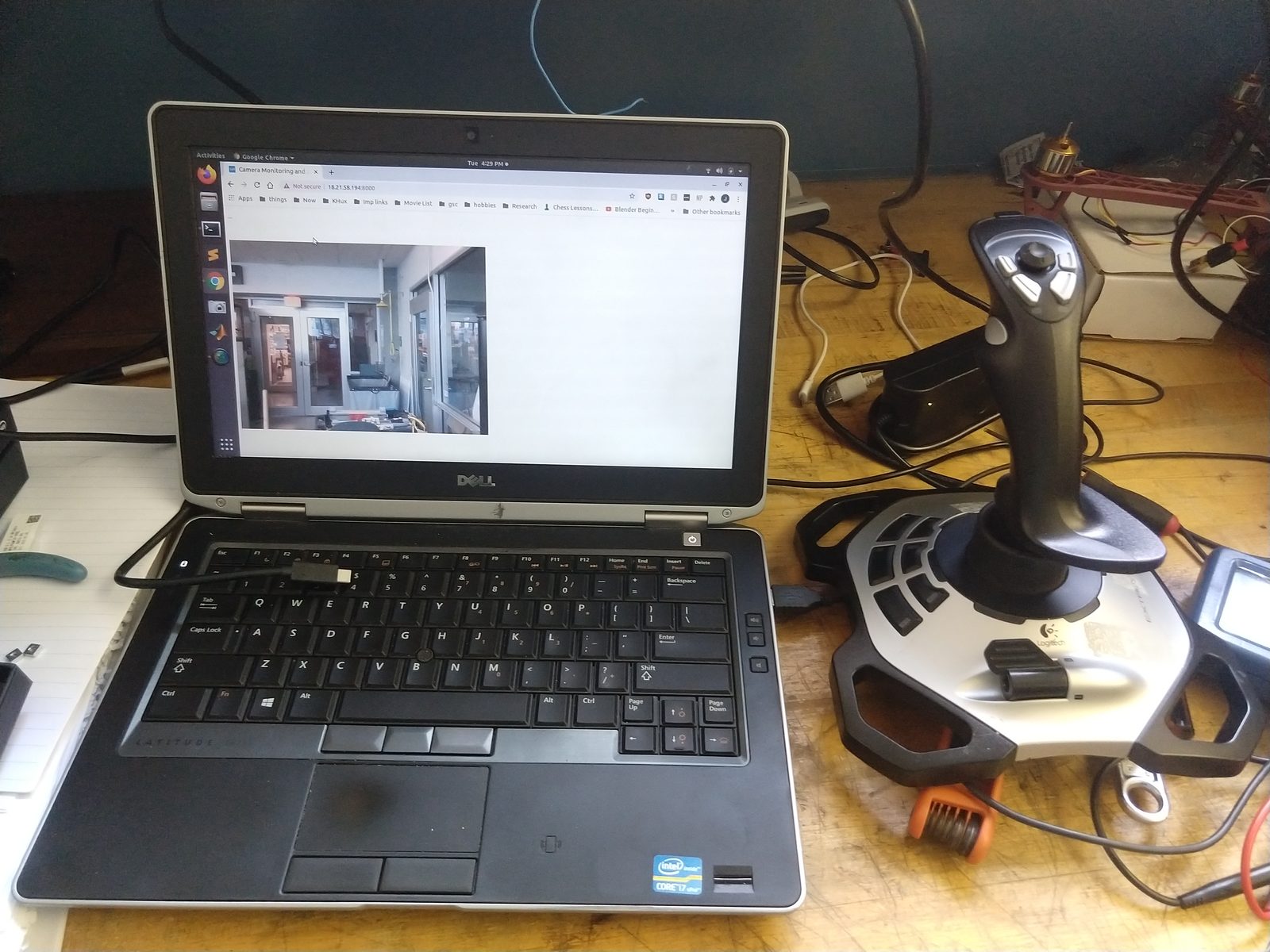
Teleoperation runs through a browser on the same network — a camera feed from the robot’s depth cameras with a joystick driving the base.
Going past the brief
The mobile platform gives one degree of freedom in the plane, which is enough to sweep a room but not enough to get UV into the places that actually matter — under a desk, behind a monitor, the door handle everyone touches. We worked up a multi-degree-of-freedom arm to carry a folding handheld lamp there, and sketched it at 3 and 4 DOF against off-the-shelf end effectors, with opening doors as the stretch goal.
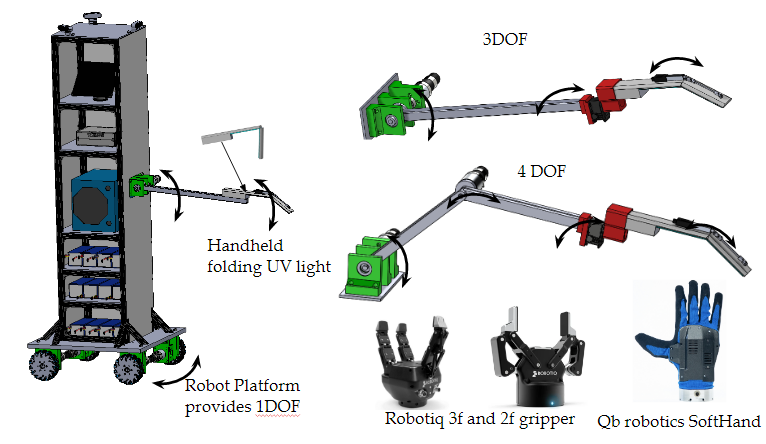
This stayed a design study — the prototype built that summer is the tower, the base, and the interlock.
Video
The prototype under teleoperation, with the mock UV lamps lit.
Two more clips of the prototype.