A magnetoencephalography scanner measures magnetic fields from the brain a billion times weaker than the Earth’s. Put anything metal near it and the measurement is gone — which is a problem if you want to study what the brain does while someone plays the piano.
Taught by Nevan Hanumara and Alex Slocum, 2.75 runs on a deterministic, peer-reviewed rapid device development process — identify a real clinical need, work through functional requirements and design parameters formally, then build and test a working prototype in one semester. I took it as a student in 2016, and liked it enough that I came back as a team mentor for three more years, helping guide the design process on other teams’ medical device projects.
My project: an MEG-compatible piano
No multi-note instrument existed that was explicitly compatible with magnetoencephalography (MEG) — the kind of brain-music interaction research MEG enables needed an instrument that wouldn’t introduce any magnetic interference into an extremely sensitive, magnetically shielded scanning environment. Working with Julian Chacon, Daniel Rathbone, and Hank Yang, I built a 25-key, all-polymer keyboard connected by fiber optic cables to an electronics box that sits entirely outside the shielded room — no metal, no electrical current anywhere near the scanner.
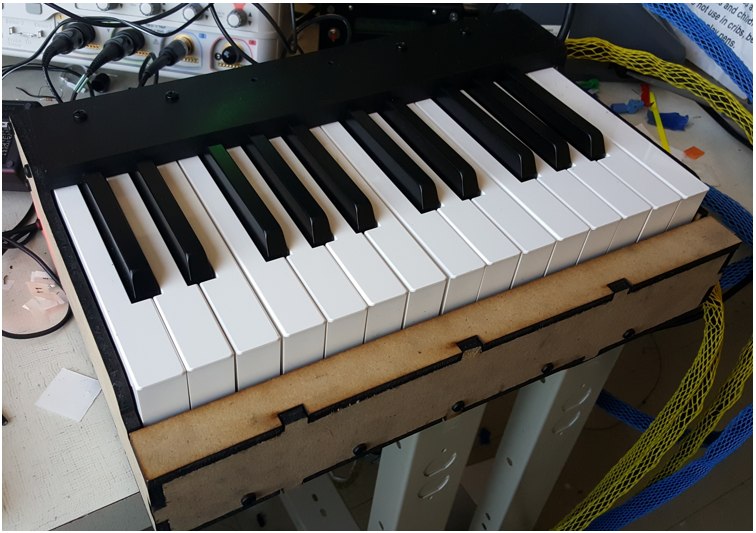
We started from real Yamaha electric piano keys for a familiar feel, then built a custom sensing mechanism underneath: each key drives a 3-state optical encoder — a strip printed with transparent, semi-transparent, and opaque bands — that a pair of fiber-optic transmitter/receiver pairs read as the key moves. ULTEM springs and Delrin locating pins hold the encoder aligned to the fiber bundle under each key.
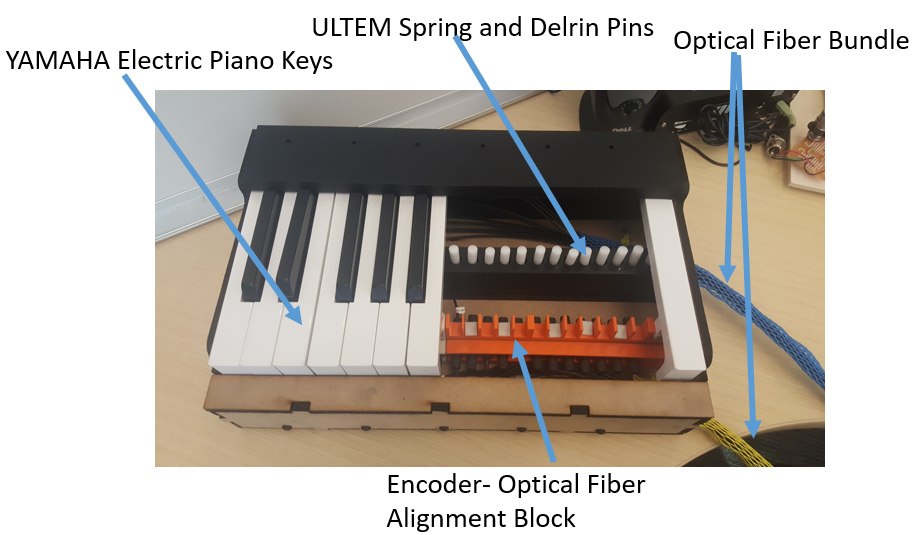
On the electronics side, a transimpedance amplifier converts the fiber’s light intensity into a voltage, two comparators turn that into a clean key-state signal, and an MSP432 microcontroller calculates velocity from the timing between transitions and outputs standard MIDI to an external synthesizer — plus a trigger signal to sync with the MEG data acquisition system. Measured latency between a key press and audio output was 5ms, reliably under the ~25ms threshold for human-perceptible delay.
The keyboard being played, with the fibre-optic key sensing that keeps metal out of the scanner.
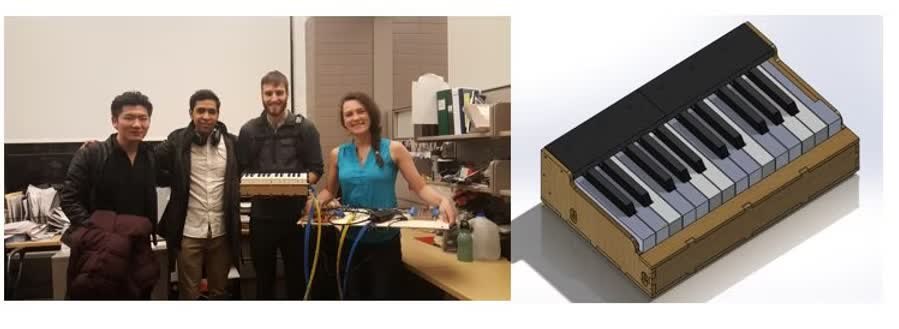
This became a published paper — see Publications — presented at EMBC 2017 in South Korea.
Projects I’ve mentored
Since 2017 I’ve mentored other 2.75 teams through the same process, mostly on the mechanical design side. A few highlights:
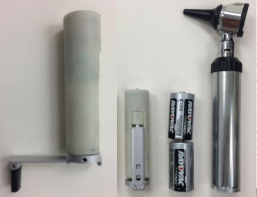
Crank-Powered Battery Replacement for Otoscopes
A hand-crank-powered module built to the exact size and electrical contacts of two C-cell batteries, so it drops into any existing LED otoscope with zero modification — aimed at clinics without reliable grid power or replacement batteries. A few minutes of comfortable cranking powers a full day of patient exams.
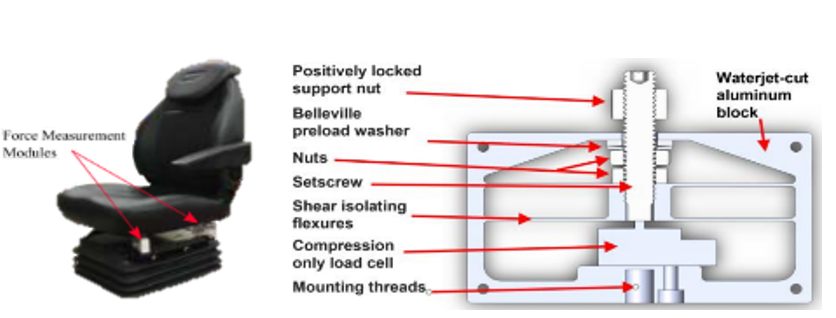
Center of Gravity Tracker for Operator Fatigue Detection
A low-cost sensor that tracks a seated operator's center of gravity from four flexure- protected load cells built into the seat mounts, aimed at non-invasively detecting driver fatigue in heavy machinery — no electrodes, no cameras, nothing the operator has to wear.
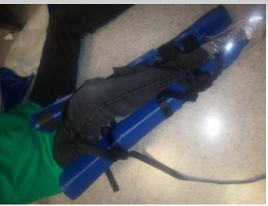
Distal Extremity Fracture Stabilization (Origami Splint)
A folding-panel splint for EMTs — Lexan panels linked by Kevlar fabric hinges fold down to 8"×8"×1" for storage, then unfold and Velcro-strap around a leg. Held 2700N in bending tests (5.8× the target load) and can reconfigure into two board splints for angled fractures.
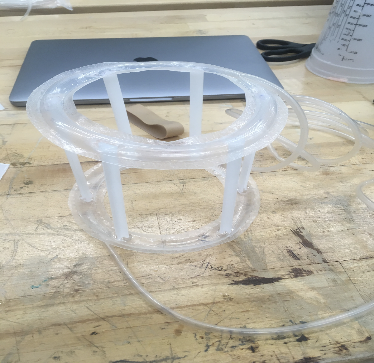
Device Prototype for Vaginal Delivery of Extremely Preterm Fetuses in the Breech Presentation
A two-part device to enable vaginal delivery of extremely preterm breech fetuses without head entrapment: a saline-filled cervical balloon that dilates the cervix, and a cervical retractor built from inflatable rings and curved beams that holds the birth canal open during delivery. See also Publications.
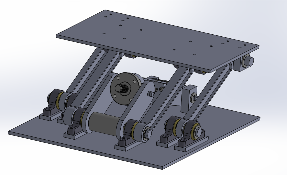
Portable Powered Seat-to-Stand Lifting Device
A compact, portable lift mechanism aimed at helping physically impaired users move from sitting to standing without a caregiver's assistance.
Video
A second demonstration of the same prototype.