A team robot that had to run a slalom course, pull a bucket off a rack, lift seven tennis balls off a three-tiered stand, and drop them all in the bucket — without knocking anything over.
Built from a stockroom of 80/20 extrusion, PVC pipe and small gearmotors, this was where I first went through a full, formal design process: run a weighted decision matrix before committing to a concept, build a prototype, watch it fail in a way you didn’t expect, and fix it without starting over from scratch.
Working in a five-person team (Team 1A), I mostly owned budget tracking and helped run the concept-selection process, on top of the general hands-on build work everyone did.
Concept selection
Before anyone touched a hacksaw, we scored six candidate drivetrain combinations against speed (30%), controllability (40%), size (20%), and modularity (10%) — controllability got the highest weight on purpose, since knocking over a single tennis ball or bucket wiped out any time bonus. The matrix pointed us toward 13.6” drive wheels paired with 44-RPM right-angle gearmotors: fastest of everything we scored (~1.95 ft/sec) while still controllable enough with differential steering.
The manipulators
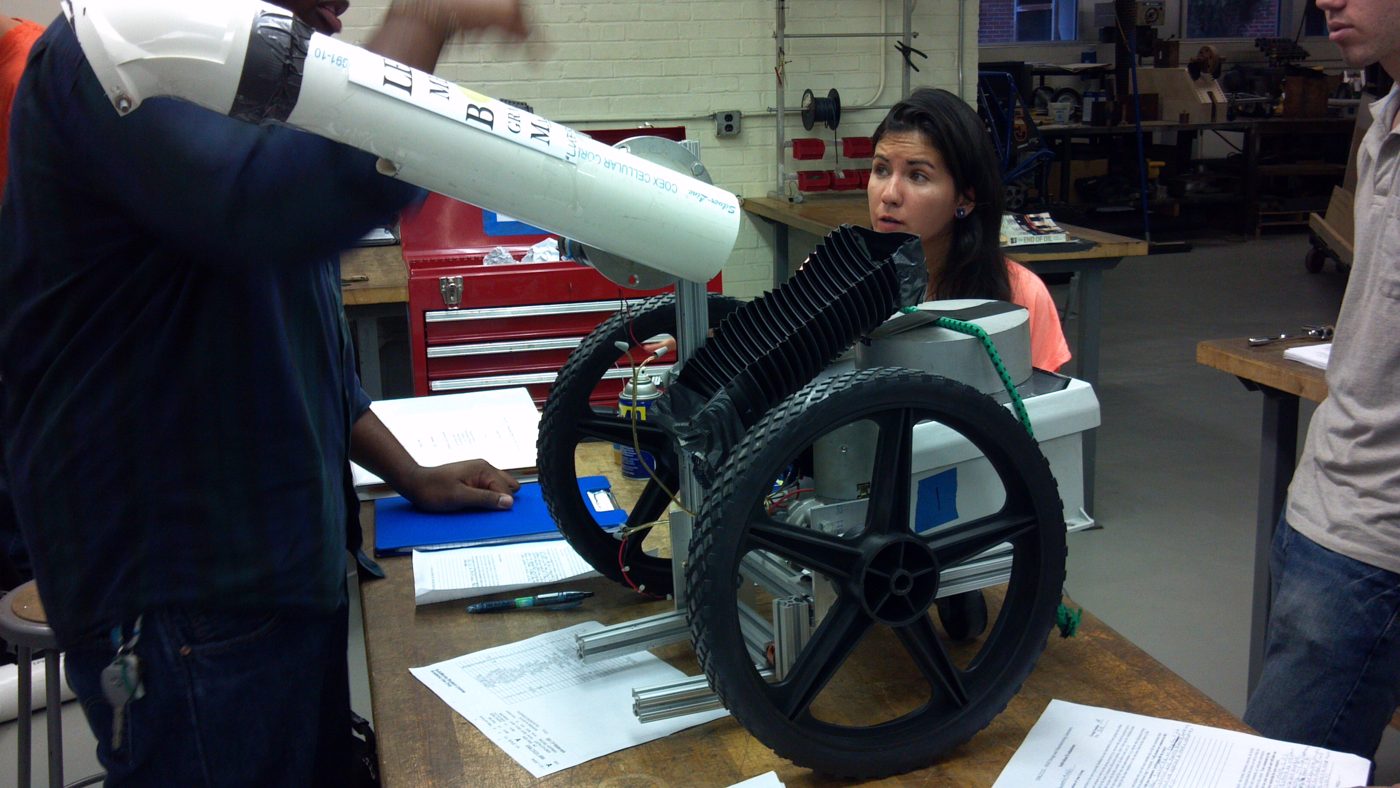
The ball-pickup mechanism is a length of 3” PVC pipe with a slot cut into the underside, mounted on a motor so it swings down onto a tennis ball, forces it up through the slot, and lets it roll down into a bucket the robot is carrying on its front.
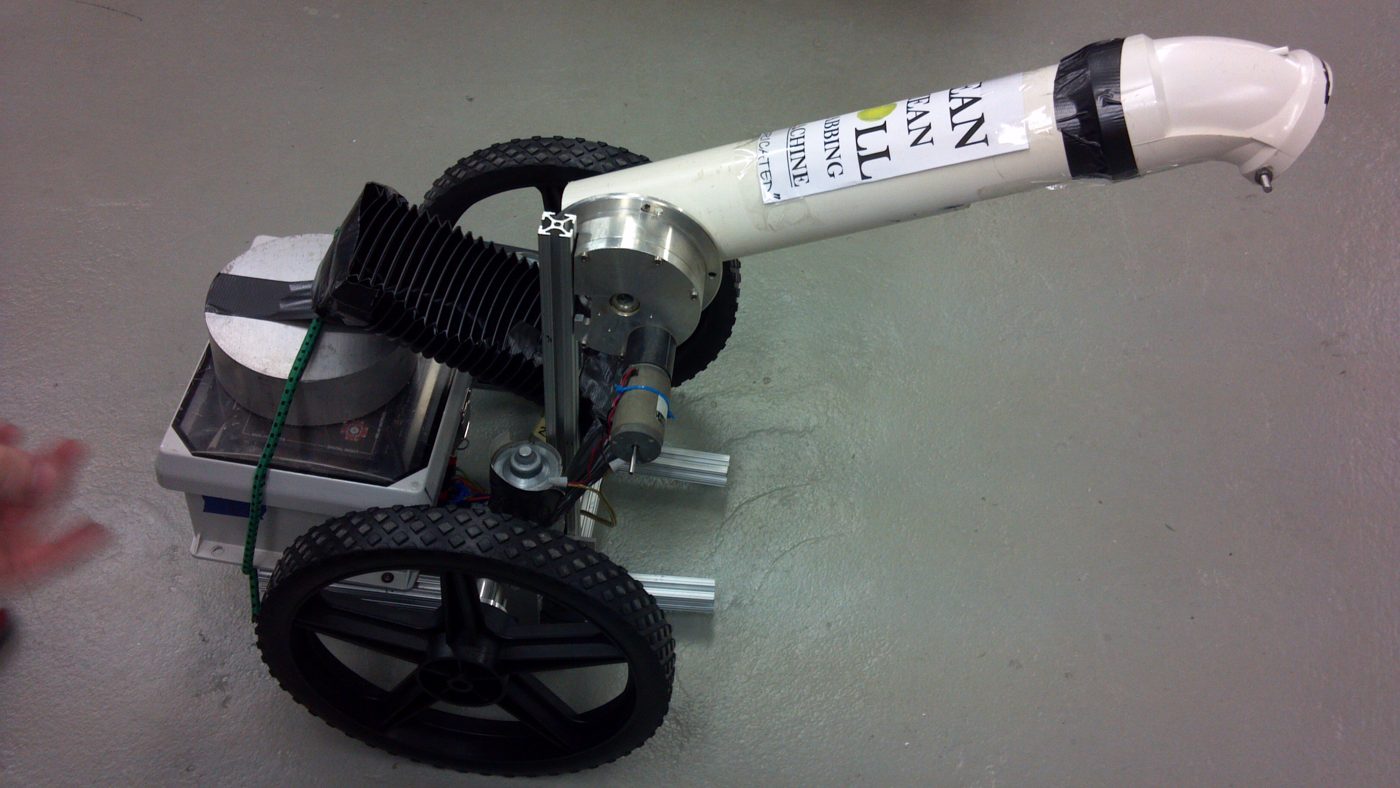
The bucket manipulator is what actually taught me something about iteration. Original plan was plywood gripper arms — simple enough, until we realized there was no good way to attach a wooden shaft to the drive motor without splitting the wood or stripping a set screw over a few runs. We scrapped it before it was ever fabricated and rebuilt the whole manipulator out of 80/20 extrusion with shaft couplings on each end instead.
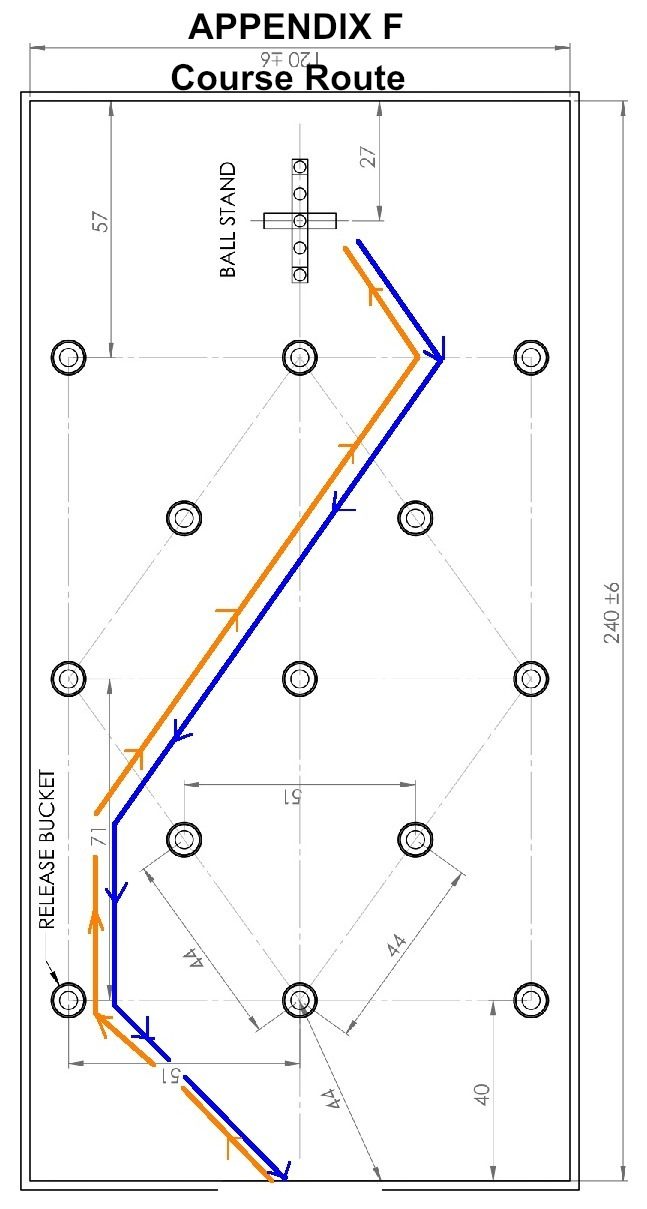
Here’s the route we planned around the ball stand and release bucket:
On competition day the robot grabbed all seven tennis balls and made it around the bucket without knocking anything over.
Competition run.