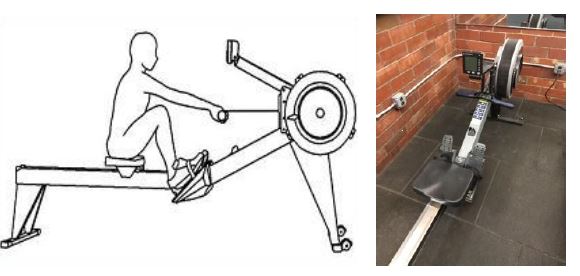
This week, a very common piece of gym equipment — the indoor rowing machine, designed to simulate what rowing a boat on water feels like.
The sliding seat
The first mechanism that caught my attention was how smoothly the seat rolls along the rail despite someone sitting on it and twisting.
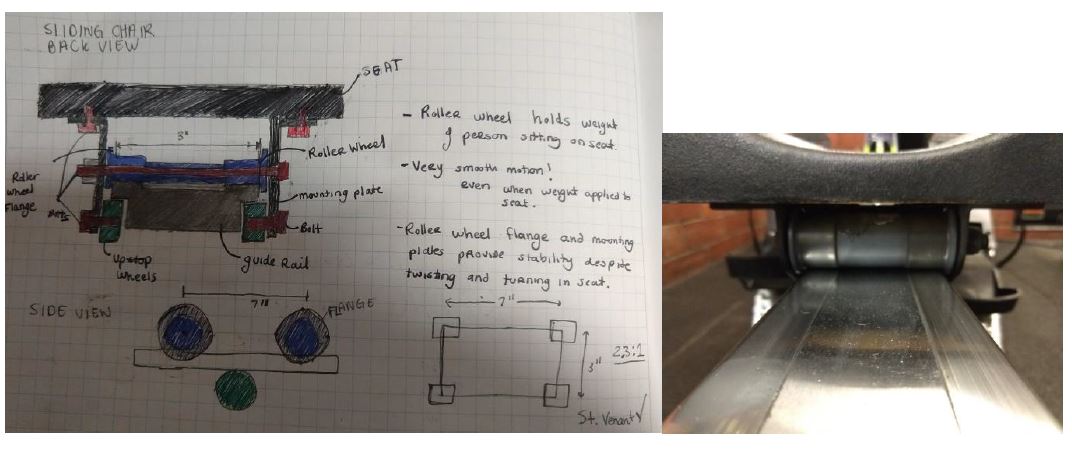
A solid shaft with a shoulder bolt — and, I assume, radial bearings — carries the rider’s weight. Flanges on the shaft limit twisting, which is what stops it jamming. An up-stop wheel on either side of the linear guide keeps the seat from lifting off the rail entirely.
Measuring it, the roller wheels are spaced to avoid jamming despite angular misalignment of the seat: 7” apart against a 3” width, a ratio of about 2.3. Thank you, St. Venant.
Under the hood
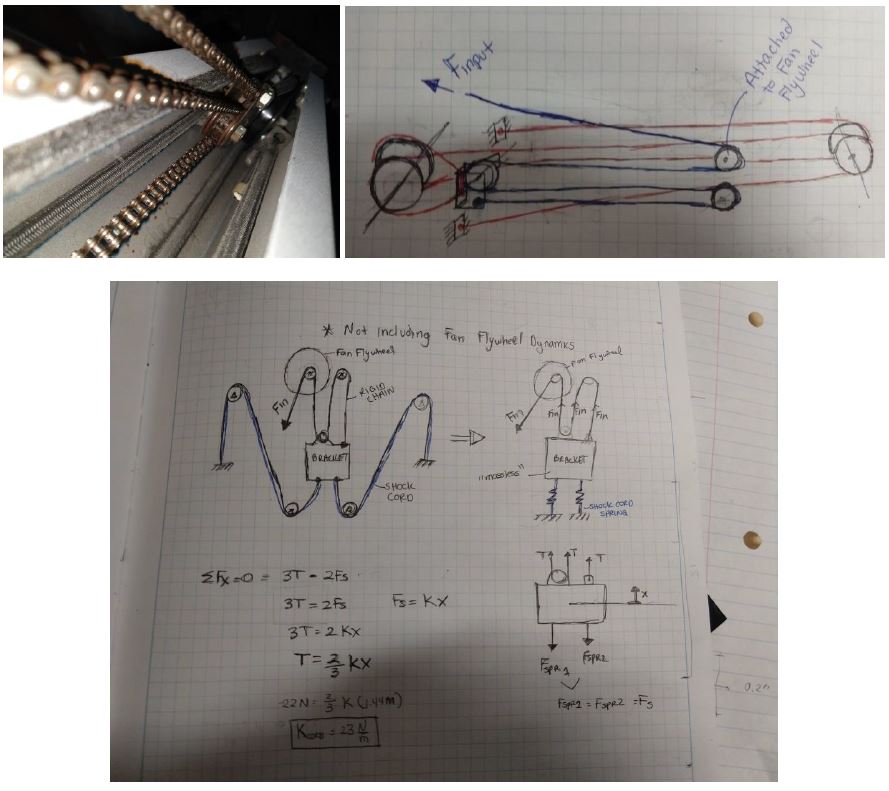
The handle connects to a roller chain that runs around a series of pulleys to a bracket. The first pulley the chain meets is directly coupled to the fan flywheel. The bracket is tied to two strands of shock cord, themselves routed through pulleys and grounded to the frame — that’s the return spring that pulls the handle back between strokes. Balancing the bracket gives a shock cord stiffness of roughly 23 N/m.
The flywheel is the whole trick
The flywheel stores energy between strokes to reproduce what water does. It works as a centrifugal fan: air enters axially, the blades throw it outward, and it exits radially. The power dissipated in dragging that air around is what you feel as resistance.
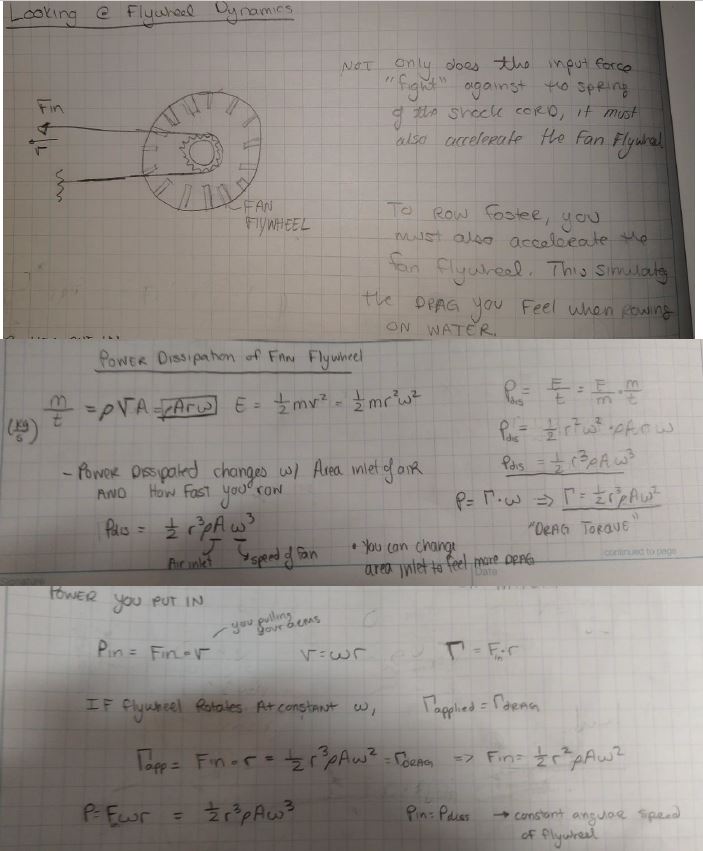
The result falls out cleanly, with r the fan radius, ρ the air density, A the inlet area and ω the fan speed:
| Power dissipated | P = ½ · r³ · ρ · A · ω³ |
| Drag torque | Γ = ½ · r³ · ρ · A · ω² |
Power dissipated goes as the cube of angular velocity — so the faster you row, the far harder it fights back. And the term that isn’t fixed by the hardware is A, the air inlet area, which is exactly what the damper lever on most rowing machines adjusts. Open it up and the fan has to move a larger mass flow, which raises the resistance you feel.