Growing up in Pensacola, Florida, I had endless opportunities to learn to ski… just kidding. I had never skied in my life until this past weekend, when I finally took a lesson. Being the mature — read: terrified — person that I am, I devoted an entire evening to the bunny slope. Which gave me ample time to study a genuinely interesting mechanism: the ski tow rope.
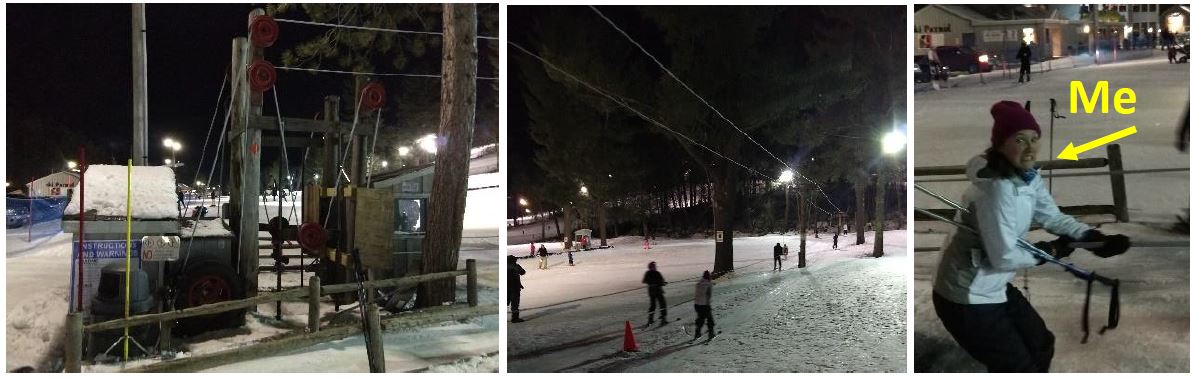
A tow rope is an extremely long rope belt-drive and pulley system. Power is transmitted through the friction connection between the rope and a tractor wheel acting as the drive pulley. The detail that caught my eye was a hanging mass suspended from one of the pulleys — as riders grabbed the rope, that pulley moved up and down.
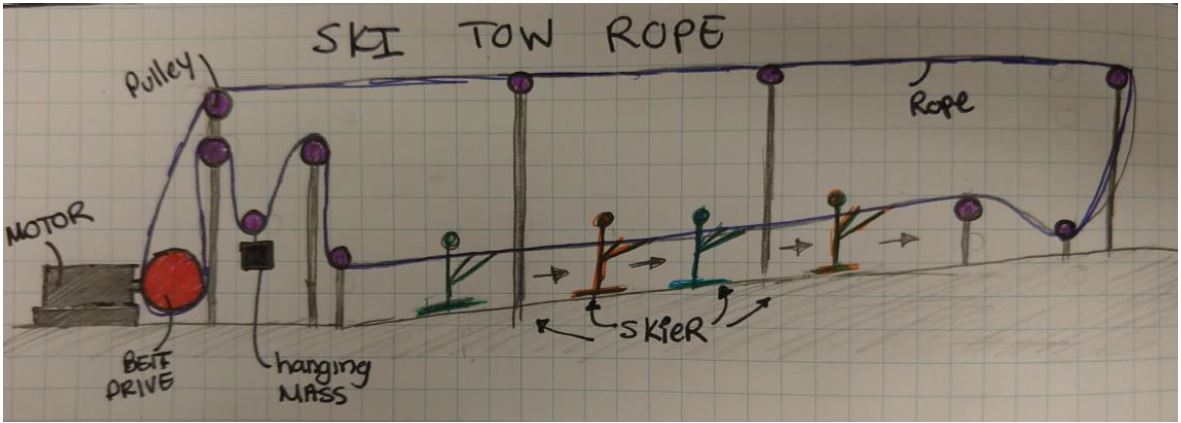
The resistance the rope has to overcome
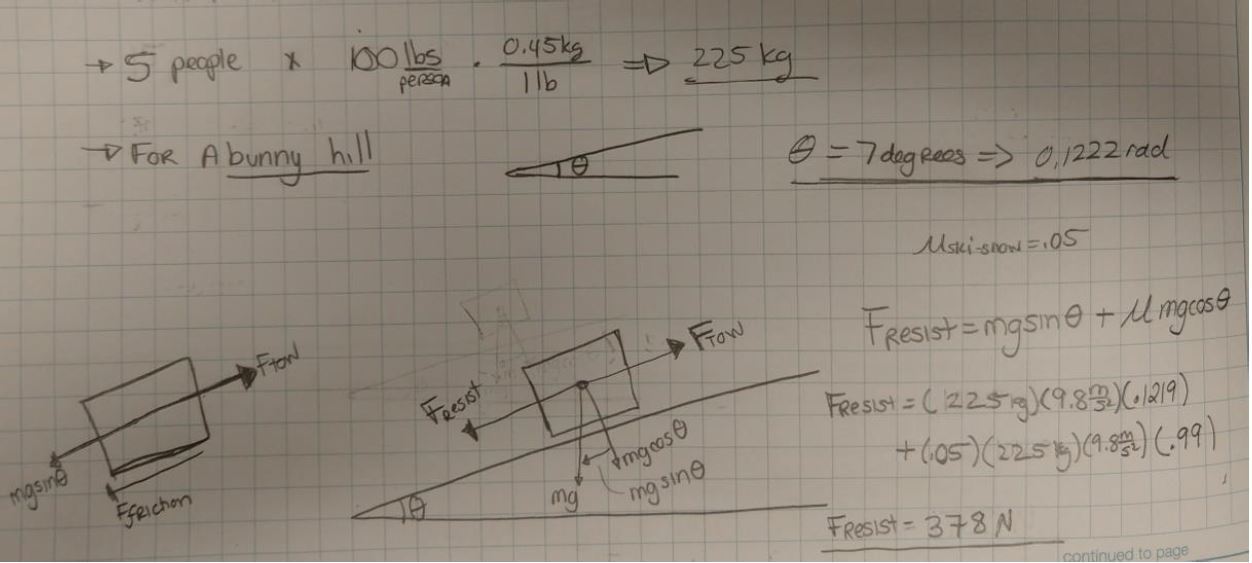
Five skiers at 100 lb each, a 7° slope, and a ski-on-snow friction coefficient of 0.05 give a resistance force of about 378 N. That covers both the friction of the skis on snow and the component of each person’s weight acting down the hill.
Sizing the hanging mass
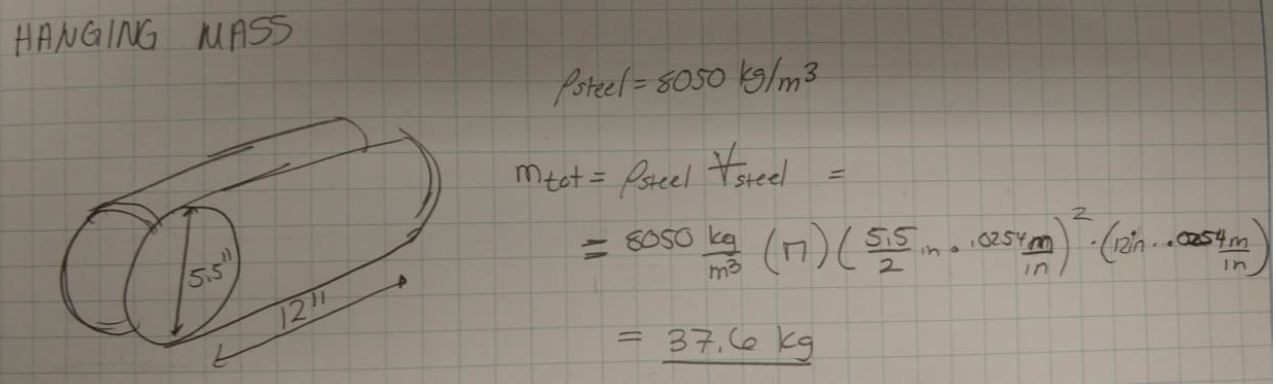
Roughly 37.6 kg of steel. Its job becomes clear once you write the force balance at the pulley it hangs from: with the rope leaving at angle θ either side, 2T cos θ = mg, so
T = mg / (2 cos θ) — the tension is set by the hanging angle.
How tension propagates
If you have ever pulled on a rope you know it goes slack when it isn’t in tension. Much like preloading a spring, the tension just before the point where a person grabs the rope is lower than just after it.
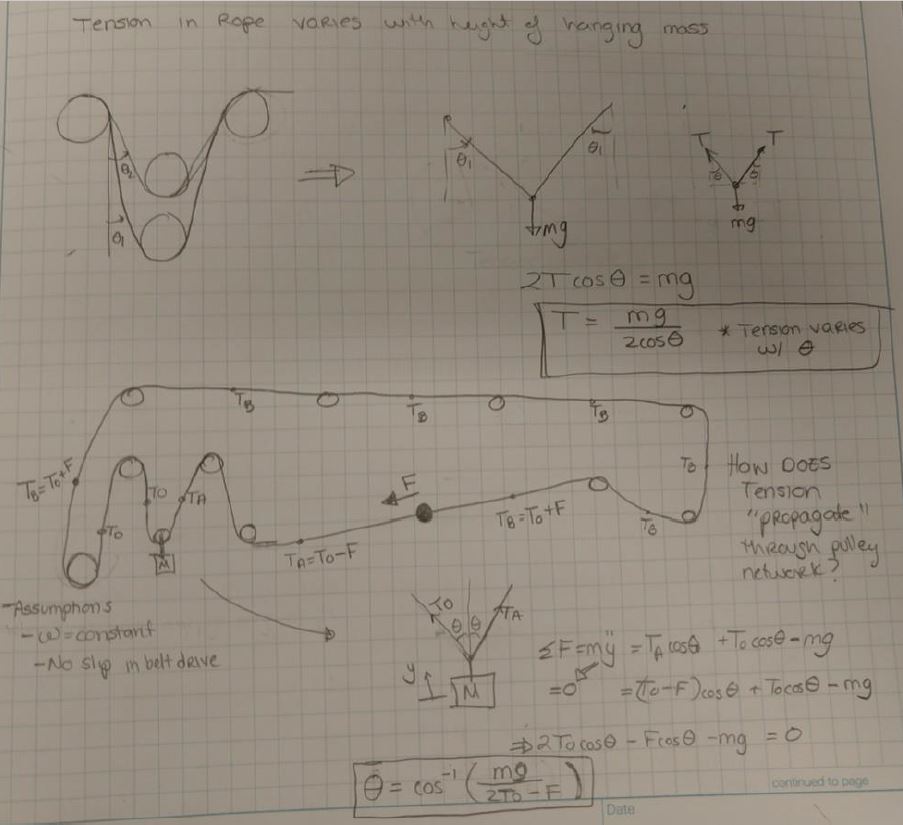
Working the balance at the hanging mass with the loaded and unloaded rope tensions on either side gives the hanging angle as a function of the pre-tension and the skiers’ load.
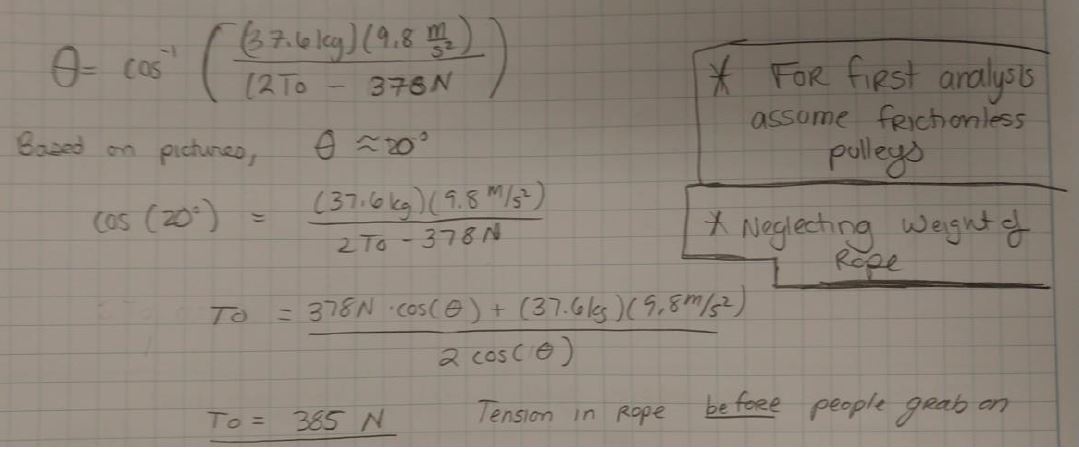
Reading the hanging angle off my photographs as roughly 20°, the pre-tension comes out at 385 N — that’s the tension in the rope before anyone grabs it. For this first-order pass I left out pulley efficiency losses and the weight of the rope, and assumed the rope runs without slip over the tractor wheel at constant speed.
Is “no slip” actually reasonable?
That assumption deserves a check, and the capstan equation provides it.
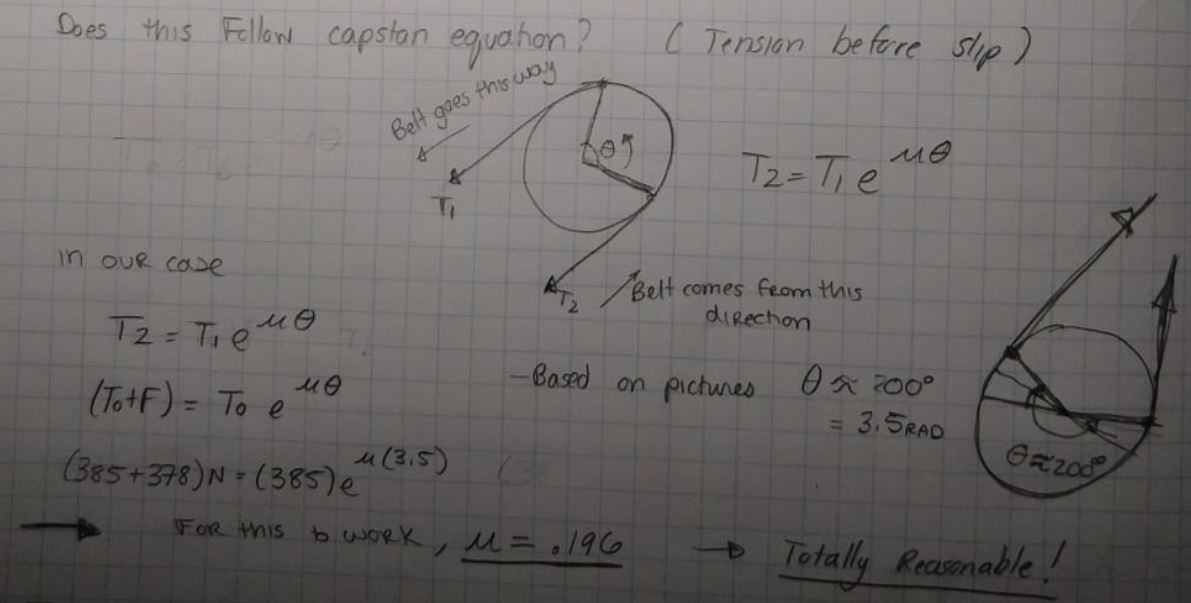
With about 200° of wrap on the tractor wheel, transmitting that tension without slipping needs a friction coefficient of 0.196 — entirely reasonable for a rope on a rubber tyre.
And will the rope hold?
Assuming the tow rope behaves like nylon, a 1.5” nylon rope has a breaking strength of 216 kN. Running the numbers at a hanging angle of 89° from vertical — nearly horizontal to the pulleys — 24 adults at 150 lb each could be towed with the rope at about one tenth of its breaking stress.
Technically more than that could be pulled, but then the capstan equation becomes the binding constraint rather than the rope: the tractor wheel has to be able to physically transmit the tension. And in practice the hill is small, so more than about 15 people on the rope would be unsafe anyway, purely from the spacing needed to stop inexperienced skiers piling onto each other.
All in all, I’m glad I went skiing — and glad I took the time to understand the physics of this thing.